

 by aarti
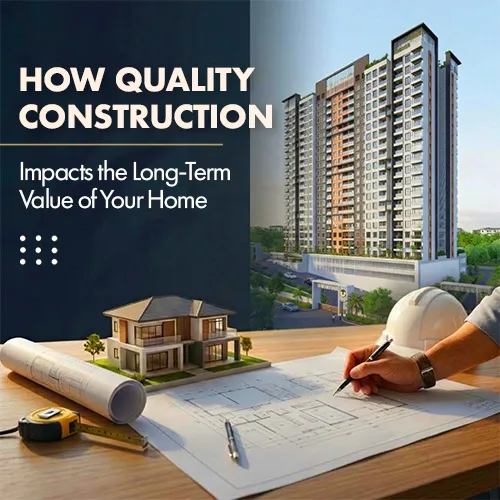
How Quality Construction Impacts the Long-Term Value of Your Home
A home is often the biggest purchase of your life. Most buyers focus on location, price, and layout. Few think about what lies inside the walls. That is a costly miss.
Quality construction shapes how your home ages, how much you spend on repairs, and what it sells for years later. A well-built home holds its worth. A poorly built one loses it fast.
In this blog, you will learn why build quality matters and how to spot it before you buy.
What Is Quality Construction in a Home?
A quality home is built to last. It is not about luxury fittings or bold designs. It is about the things you cannot always see.
A Strong Foundation and Structure
Everything rests on the foundation. If it is weak, cracks appear in walls and floors. Doors stop closing properly. Repairs become costly and stressful.
Good builders use tested concrete and quality steel. They follow safety codes. They also plan for local soil and weather.
Better Materials
All elements, including cement, tiles, paint, piping, and wires, are crucial. While budget options may be fine on handover day, they will not last long as time goes by. Problems like fading, leaking, and wear and tear can occur in due time.
Though top-grade materials cost more initially, the investment pays back as time goes by.
Skilled Craftsmanship
Regardless of the material selected, experienced specialists are essential. Straight walls, even plaster, and neat joints show careful work. So do well-sealed bathrooms and properly fitted windows.
Regular site supervision makes a significant difference here.
How Build Quality Protects Your Home’s Value
Build quality affects your finances in three clear ways.
Lower Maintenance Costs
A well-built home needs fewer repairs. You avoid frequent seepage, cracked plaster, and electrical faults.
Think of a leaking terrace. Fixing it once is annoying. Fixing it every monsoon is draining. Over ten years, those small bills add up to a large amount.
Higher Resale Value
Buyers notice the condition of a property. Consider two flats in the same neighbourhood. In one flat, the walls are clean, the floors are in perfect condition, and there are no damp patches. In the other flat, there are stains and uneven tiles.
The former would sell quicker and at a higher price.
Buyers also trust a well-kept home. As a result, they negotiate less.
A Longer Life for the Property
Every building ages. Good construction slows that down. A well-built home can stay safe and comfortable for decades. That stability protects the money you paid.
Residential Construction Quality and Real Estate Investment
If you see your home as an investment, build quality matters even more. Property value depends on demand. Demand depends on condition, safety, and trust.
Homes made with quality materials provide investors with distinct benefits. Tenants usually prefer to stay longer in apartments that are well-maintained. Buyers also feel more confident about these properties when it is time to sell.
Strong residential construction quality helps the whole project too. When a society stays neat and functional, every owner gains. When one building decays, it can pull nearby values down.
That is why smart buyers treat real estate investment as more than a location game. The build behind the address counts just as much.
Benefits of Buying a Quality Constructed Home
Here is what you gain:
Safety
Strong structures protect your family in heavy rain and other stress.
Appreciation
Proper heating, cooling, and ventilation systems can help maintain the property’s value.
Ease
Working with an expert saves you time and energy.
Happiness
There is less to worry about when your home is built properly and maintained well.
Better Returns
A quality property keeps its value and can sell well.
Each of these benefits builds on the others. A safe, comfortable home is also easier to sell.
How to Check Construction Quality Before You Buy
You do not need to be an engineer. A few simple checks can help a lot.
Research the Builder
Look at past projects. Visit one that is five years old and see how it has aged.
Verify the Contractor’s Credibility
Check the track record of the contractors involved in the construction process.
Check the Construction Materials
Take note of the materials used in the construction process and understand their quality.
Review the Contract Carefully
Explore all aspects of the contract thoroughly before signing it.
During a site visit, tap the walls and look for cracks, uneven tiles, and damp marks. Evaluate every tap and switch.
Bring an Expert
A civil engineer or home inspector can identify issues you may miss.
Your real estate partner matters as well. Choose one that is open about the project and answers questions clearly. Oree Reality, for example, helps buyers in Pune explore projects such as Cloud 51 in Bavdhan. Ask any advisor for site visits, documents, and specifications before you decide.
Conclusion
Quality construction is not a bonus feature. It is the base of your home’s long-term value. It cuts repair costs, lifts resale price, and keeps your family safe.
If you are planning a real estate investment, put build quality at the top of your checklist. Before you sign, look beyond the view and the price tag. Check the foundation, the materials, and the builder.
A little care today can protect your home’s worth for decades.


